 090003 25483
 Yashoda Hospitals Hitec City Hyderabad, Kothaguda, Telangana 500084
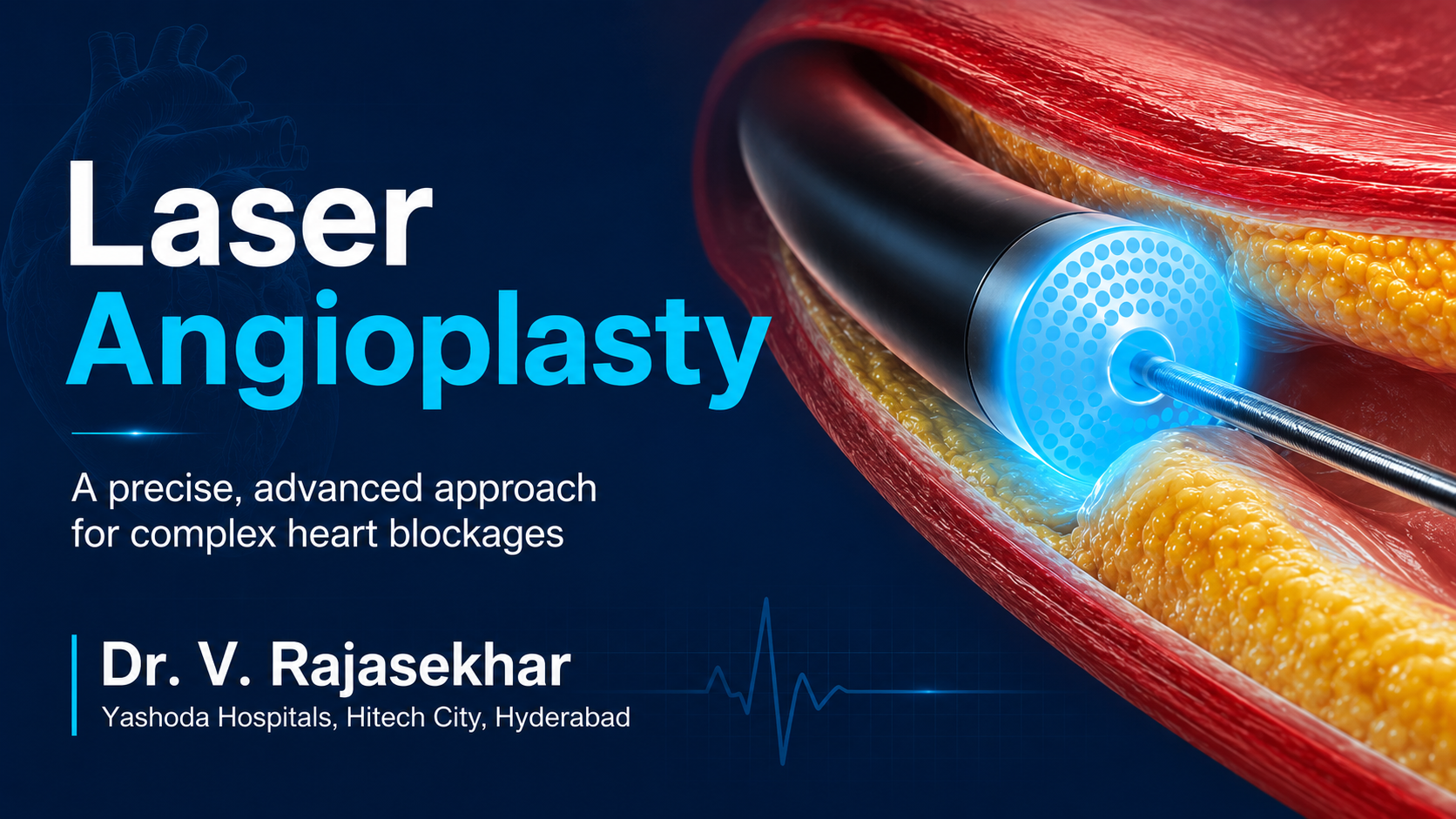
Heart blockages are commonly treated with angioplasty and stenting. For many patients, conventional balloon angioplasty and stent placement work well. However, not every blockage is simple. Some blockages are very hard, heavily calcified, long-standing, previously treated, or difficult for regular balloons and devices to cross. In such complex situations, advanced techniques may be required to safely prepare the artery and restore blood flow.
One such advanced technique is laser angioplasty, also known as excimer laser coronary angioplasty. It is a specialized procedure used in selected patients where a laser catheter helps modify or clear difficult plaque inside the coronary artery. The goal is not simply to “burn away” a blockage, but to create a safer and more effective pathway for further treatment, such as balloon expansion or stent placement.
For patients with complex coronary artery disease, laser angioplasty can offer an important treatment option when conventional methods may be challenging.
What Is Laser Angioplasty?
Laser angioplasty is a minimally invasive cardiac procedure performed through a catheter. During the procedure, a thin laser catheter is guided into the blocked coronary artery. The laser delivers controlled pulses of ultraviolet energy to the blockage. This energy helps break down or vaporize selected plaque material into very tiny particles, making it easier to open the artery.
Unlike open-heart surgery, laser angioplasty is performed through a small puncture, usually in the wrist or groin. It is generally done as part of a planned angioplasty procedure in a cardiac catheterization lab.
Laser angioplasty is usually not used for every routine blockage. It is reserved for selected cases where the blockage is complex, resistant, or difficult to treat with standard angioplasty tools.
Why Are Some Heart Blockages Difficult to Treat?
A heart blockage becomes complex for many reasons. Some plaques contain a high amount of calcium, making them extremely hard. Some blockages are long-standing and completely or nearly completely obstruct the artery. Some occur inside a previously placed stent, known as in-stent restenosis. In some patients, the artery may be tortuous, narrow, or difficult to access.
In these situations, a regular balloon may not expand properly. A stent may not open fully if the artery has not been prepared correctly. If a stent is placed in an inadequately prepared artery, the long-term result may be less effective.
This is why advanced plaque modification techniques like laser angioplasty can play an important role. By preparing the blockage more precisely, the cardiologist can improve the chances of proper balloon expansion and optimal stent placement.
When Is Laser Angioplasty Considered?
Laser angioplasty may be considered in selected patients with:
Heavily calcified coronary blockages
Long-standing or resistant blockages
Blockages that cannot be crossed easily with standard devices
Blockages that do not open properly with a balloon
Re-narrowing inside a previous stent
Complex coronary artery disease in high-risk patients
Certain cases where conventional angioplasty may not be enough
The decision depends on the patient’s angiogram findings, symptoms, overall heart condition, kidney function, risk profile, and the technical nature of the blockage. It is not a one-size-fits-all treatment.
How Does Laser Angioplasty Work?
The procedure begins like a standard angioplasty. The patient is shifted to the catheterization lab. Local anesthesia is given at the access site, usually the wrist or groin. A thin catheter is advanced through the blood vessel toward the heart artery.
Once the cardiologist reaches the blocked artery, imaging and angiographic guidance are used to understand the blockage. A specialized laser catheter is then carefully advanced to the lesion. The laser energy is delivered in short, controlled pulses. This helps modify the plaque and create a channel through the blockage.
After laser treatment, the cardiologist may use a balloon to further open the artery. In many cases, a stent may be placed to keep the artery open. In some selected cases, additional imaging tools such as IVUS or OCT may be used to check how well the artery has opened and whether the stent is properly expanded.
The entire approach is carefully planned and performed by an experienced interventional cardiology team.
Benefits of Laser Angioplasty in Selected Patients
The main advantage of laser angioplasty is precision in complex blockages. It can help the cardiologist treat lesions that are difficult to cross or expand with conventional angioplasty.
Potential benefits include:
Better preparation of complex plaque
Improved balloon expansion in difficult lesions
Better stent delivery in selected cases
Useful option for in-stent restenosis
Minimally invasive approach compared with open surgery
May help selected high-risk patients avoid more invasive procedures
Can be combined with other advanced coronary techniques
However, the benefit depends on careful patient selection. Laser angioplasty is not required for every patient with heart blockage.
Is Laser Angioplasty Safe?
Laser angioplasty is a specialized procedure and is generally considered safe when performed in the right patient by an experienced team. Like all cardiac interventions, it does carry certain risks. These may include artery injury, bleeding from the access site, rhythm changes, kidney-related concerns due to contrast dye, or the need for emergency management in rare cases.
This is why proper evaluation before the procedure is very important. The cardiologist assesses the patient’s age, heart pumping function, kidney status, diabetes, blood pressure, previous stents, bleeding risk, and overall medical condition before recommending the procedure.
In complex heart blockages, safety comes from three things: choosing the right patient, using the right technology, and having an experienced heart team.
Laser Angioplasty vs Regular Angioplasty
Regular angioplasty uses a balloon to open the narrowed artery. A stent is often placed to keep the artery open. This works well for many patients.
Laser angioplasty is different because it uses laser energy to modify difficult plaque before ballooning or stenting. It is not a replacement for regular angioplasty in every case. Instead, it is an advanced support technique used when regular angioplasty may be difficult or inadequate.
In simple terms, regular angioplasty opens the artery with balloon pressure, while laser angioplasty helps prepare a difficult blockage so that the artery can be opened more effectively.
Who May Need Laser Angioplasty?
A patient may be evaluated for laser angioplasty if they have symptoms of coronary artery disease and the angiogram shows a complex blockage. Symptoms may include chest pain, breathlessness, heaviness in the chest, sweating, fatigue on exertion, jaw or arm discomfort, or reduced exercise capacity.
Patients who previously had stents and now have re-narrowing may also require special evaluation. Similarly, elderly patients or those with diabetes, kidney disease, or multiple blockages may sometimes present with more complex coronary anatomy.
The final decision is made only after a detailed cardiac assessment.
Recovery After Laser Angioplasty
Recovery is usually similar to angioplasty recovery. Most patients are monitored in the hospital after the procedure. The duration of stay depends on the complexity of the case and the patient’s overall condition.
After discharge, patients are advised to follow medications strictly. Blood thinners, cholesterol medicines, blood pressure control, diabetes control, and lifestyle changes are very important. Angioplasty opens the artery, but long-term heart protection depends on continued medical care and risk factor control.
Patients should avoid stopping medicines without consulting their cardiologist. Regular follow-up is essential.
Lifestyle After Laser Angioplasty
The procedure treats the blockage, but heart disease management continues beyond the catheterization lab. Patients should focus on:
Heart-healthy diet
Regular walking or supervised cardiac rehabilitation
Smoking cessation
Diabetes and blood pressure control
Cholesterol management
Weight control
Stress reduction
Regular cardiology follow-up
A successful angioplasty result should be protected with disciplined long-term care.
Why Expertise Matters in Laser Angioplasty
Laser angioplasty requires experience, judgment, and technical precision. The cardiologist must understand which lesion needs laser treatment, how much energy to deliver, when to stop, and how to combine it with ballooning, stenting, or intravascular imaging.
Complex coronary interventions are not just about technology. They are about decision-making. A skilled interventional cardiologist evaluates the patient as a whole, not just the blockage seen on the angiogram.
About Dr. V. Rajasekhar
Dr. V. Rajasekhar is a senior heart specialist at Yashoda Hospitals, Hitec City, Hyderabad.
Doctor Details:
Dr. V. Rajasekhar
MD, DM Cardiology
Senior Consultant Interventional Cardiology & Electrophysiology
Certified Proctor for TAVR & Clinical Director
Yashoda Hospitals, Hitec City, Hyderabad
Dr. V. Rajasekhar has expertise in clinical cardiology, complex coronary interventions, angioplasty, structural heart interventions, TAVR, electrophysiology, and catheter-based cardiac procedures. His experience in advanced interventional cardiology is especially relevant for patients with complex heart blockages who may need carefully planned procedures such as laser angioplasty.
Conclusion
Laser angioplasty is an advanced, precise, and minimally invasive technique used for selected patients with complex heart blockages. It is especially useful when blockages are hard, calcified, resistant, previously treated, or difficult to open with conventional methods.
The most important point is patient selection. Not every heart blockage needs laser angioplasty. But for the right patient, in the hands of an experienced interventional cardiologist, it can be a valuable option to restore blood flow and improve treatment outcomes.
If you have been diagnosed with a complex heart blockage, recurrent stent narrowing, or difficult coronary artery disease, consult an experienced interventional cardiologist to understand whether advanced angioplasty techniques may be suitable for your condition.
FAQs on Laser Angioplasty
1. What is laser angioplasty?
Laser angioplasty is an advanced catheter-based procedure that uses controlled laser energy to modify or clear difficult plaque inside a blocked coronary artery. It is usually performed as part of angioplasty in selected complex cases.
2. Is laser angioplasty different from regular angioplasty?
Yes. Regular angioplasty mainly uses a balloon and stent to open the artery. Laser angioplasty uses laser energy to prepare difficult blockages before ballooning or stenting.
3. Who needs laser angioplasty?
Patients with heavily calcified blockages, resistant blockages, in-stent restenosis, or blockages that are difficult to cross or expand may be considered for laser angioplasty.
4. Is laser angioplasty painful?
The procedure is usually done under local anesthesia with sedation or appropriate monitoring. Patients may feel pressure at the access site, but the procedure itself is generally not painful.
5. Is laser angioplasty safe for elderly patients?
It can be considered in elderly patients if the cardiologist finds it suitable. The decision depends on the patient’s overall health, heart function, kidney function, bleeding risk, and blockage complexity.
6. Does laser angioplasty remove the need for a stent?
In many cases, a stent may still be required after laser treatment. The laser helps prepare the artery. Whether a stent is needed depends on the blockage and final angioplasty result.
7. How long does recovery take?
Recovery is usually similar to regular angioplasty, but it depends on the complexity of the case and the patient’s health. Some patients may go home within a short hospital stay, while complex cases may need longer monitoring.
8. Can laser angioplasty treat a previously placed stent blockage?
Yes, in selected cases of in-stent restenosis, laser angioplasty may help modify tissue or plaque inside the stent before further treatment.
9. Is laser angioplasty available for all heart blockage patients?
No. It is not required for every patient. It is mainly used for selected complex coronary blockages where standard angioplasty techniques may be difficult.
10. Whom should I consult for laser angioplasty in Hyderabad?
Patients with complex coronary artery disease can consult an experienced interventional cardiologist such as Dr. V. Rajasekhar, Senior Consultant Interventional Cardiology & Electrophysiology, Yashoda Hospitals, Hitec City, Hyderabad, for evaluation and treatment guidance.